

 Thermal labels



OEM Thermal Sticker Paper - Pricelist & Suppliers for Your Needs
Thermal sticker paper is a direct thermal adhesive paper material used for printing labels without ink, toner or ribbon. It is widely used for barcode labels, shipping labels, supermarket scale labels, retail price labels, warehouse labels, food packaging labels and logistics tracking labels.
For B2B buyers, thermal sticker paper is not only about label size. The material structure, thermal coating, adhesive performance, release liner, die-cutting accuracy, roll direction, printer compatibility and storage conditions all affect printing quality and label application performance.
Sailing Paper supplies thermal sticker paper in finished rolls, sheets, custom die-cut labels, jumbo rolls and slit rolls for distributors, label converters, logistics companies, retail suppliers, e-commerce sellers and private label customers. We support custom sizes, adhesives, packaging, OEM branding and long-term supply plans.
What Is Thermal Sticker Paper?
Thermal sticker paper is a pressure-sensitive label material with a thermal-sensitive surface coating. When it passes through a direct thermal printer, the printer head applies heat to the surface and creates text, barcodes, QR codes, numbers or variable information.
Unlike ordinary sticker paper, thermal sticker paper does not require inkjet printing, laser printing or ribbons. It is mainly designed for direct thermal printers.
Common printed content includes:
- Barcodes
- QR codes
- Shipping addresses
- Tracking numbers
- Product names
- Prices
- Weight information
- Batch numbers
- Expiry dates
- Inventory codes
- Retail product information
Because it combines printing and adhesive labeling in one product, thermal sticker paper is widely used in logistics, retail, warehousing, food service, healthcare, e-commerce and industrial identification.
Thermal Sticker Paper vs Regular Sticker Paper
Many buyers search for thermal sticker paper, printable sticker paper and adhesive label paper, but these products are not the same. Choosing the wrong material may cause poor printing, unreadable barcodes or printer incompatibility.
| Item | Thermal Sticker Paper | Regular Sticker Paper |
|---|---|---|
| Printing Method | Direct thermal printing | Inkjet, laser, offset or flexo printing |
| Ink / Ribbon | Not required | Usually required |
| Common Use | Barcode, shipping, retail, logistics labels | Product stickers, packaging labels, decoration |
| Printer Type | Direct thermal label printer | Inkjet, laser or commercial printer |
| Main Advantage | Fast variable-data printing | Better for full-color graphics |
| Key Focus | Thermal coating, adhesive, die-cutting, printer compatibility | Surface finish, printability, design effect |
Thermal sticker paper is more suitable for labels that need fast printing, variable information and barcode readability.
Thermal Sticker Paper and Direct Thermal Label Paper
Thermal sticker paper is often also called direct thermal label paper or thermal adhesive label paper. These terms are closely related in B2B purchasing.
Common related keywords include:
- Thermal sticker paper
- Direct thermal sticker paper
- Thermal label sticker paper
- Thermal adhesive paper
- Direct thermal label paper
- Thermal shipping label paper
- Barcode sticker paper
- Scale label paper
- Thermal label rolls
- Printable thermal stickers
Material Structure of Thermal Sticker Paper
Thermal sticker paper usually includes three key layers: thermal facestock, adhesive and release liner. Each layer affects the final performance.
1. Thermal Facestock
The facestock is the printable surface. It contains a thermal-sensitive coating that reacts to heat during printing.
Key factors include:
- Surface smoothness
- Thermal sensitivity
- Print darkness
- Barcode readability
- Scratch resistance
- Water or oil resistance if top-coated
- Compatibility with direct thermal printers
A stable thermal coating helps ensure clear printing and fewer barcode scanning problems.
2. Adhesive Layer
The adhesive determines how well the label sticks to the target surface. Different applications require different adhesive strength.
Common adhesive options include:
- Permanent adhesive
- Removable adhesive
- Freezer-grade adhesive
- Strong adhesive
- Hot-melt adhesive
- Water-based adhesive
- Low-temperature adhesive
- Special adhesive for curved surfaces
Choosing the right adhesive is important because different surfaces, temperatures and storage conditions affect label adhesion.
3. Release Liner
The release liner protects the adhesive and supports smooth label feeding during printing and application.
Important liner factors include:
- Liner thickness
- Release force
- Smoothness
- Roll tension
- Die-cutting support
- Automatic labeling compatibility
- Printer feeding stability
For high-speed label printing or automatic labeling, liner stability is especially important.
How Thermal Sticker Paper Supports Different B2B Buyers
Different buyers purchase thermal sticker paper for different purposes. A good supplier should recommend the right label material according to the buyer’s business model.
For Label Distributors and Wholesalers
Distributors usually need popular finished label sizes, stable carton packing and repeatable supply. They may sell thermal sticker paper to local retailers, e-commerce sellers, warehouses, supermarkets and small businesses.
They usually focus on:
- Popular label sizes
- Stable adhesive quality
- Clear printing effect
- Strong carton packaging
- Private label options
- Mixed-size orders
- Fast replenishment
For E-Commerce and Logistics Suppliers
E-commerce and logistics buyers usually need thermal sticker paper for shipping labels, courier labels and parcel tracking.
Key requirements include:
- 4x6 shipping label compatibility
- Clear barcode printing
- Strong adhesive on cartons
- Smooth printer feeding
- Good roll tension
- Anti-jam performance
- Stable supply for peak seasons
This market often values printing stability and barcode readability more than decorative appearance.
For Supermarket and Retail Buyers
Supermarkets use thermal sticker paper for scale labels, price labels, fresh food labels, bakery labels and shelf identification.
Important requirements include:
- Clear price and weight printing
- Adhesive suitable for packaging surfaces
- Moisture resistance for chilled products
- Smooth peeling
- Accurate die-cutting
- Printer compatibility with scale label printers
- Stable roll direction
For Label Converters
Label converters may purchase thermal sticker paper in jumbo rolls or slit rolls for local die-cutting, printing, rewinding and packaging.
They usually care about:
- Jumbo roll width
- Coating stability
- Adhesive consistency
- Liner quality
- Die-cutting performance
- Roll tension
- Converting yield
- Custom material structure
This supply model gives converters more flexibility in label size, shape and local market packaging.
For Private Label Brands
Thermal sticker paper is suitable for private label business because it is a repeat-purchase product in logistics, retail and warehouse applications.
Private label support may include:
- OEM carton design
- Custom roll labels
- Local language packaging
- Barcode and SKU stickers
- Retail pack design
- Mixed-size product series
- Distributor brand packaging
- Custom core and roll direction
Private label packaging can help distributors improve brand recognition and reduce direct price competition.
Common Applications of Thermal Sticker Paper
Shipping Labels
Thermal sticker paper is widely used for 4x6 shipping labels, courier labels, return labels and parcel tracking labels. Strong adhesive, smooth printer feeding and barcode clarity are key requirements.
Barcode Labels
Barcode labels require high print clarity and stable scanning performance. Thermal sticker paper is commonly used for inventory management, retail product identification and warehouse tracking.
Supermarket Scale Labels
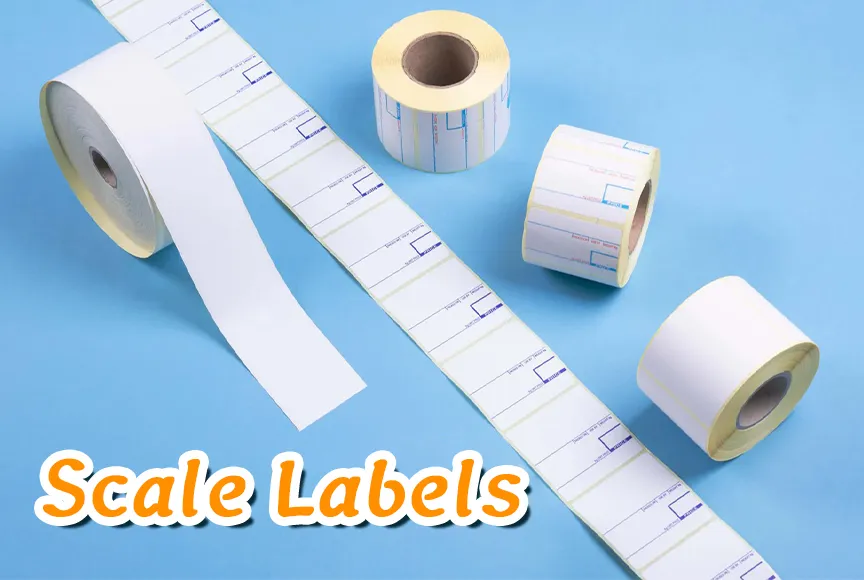
Scale labels are used for fresh food, meat, seafood, fruit, bakery and deli products. They need clear printing, accurate die-cutting and adhesive suitable for different packaging surfaces.
Retail Price Labels
Retail price labels are used for product pricing, promotion marking, shelf labeling and stock management. Thermal sticker paper helps stores print variable price information quickly.
Warehouse Labels
Warehouse labels are used for inventory identification, carton marking, shelf labels and barcode tracking. Adhesive strength and barcode readability are very important.
Food Packaging Labels
Food packaging labels may be applied to plastic trays, wrapping film, paper bags, boxes or chilled packaging. The adhesive should match the packaging surface and storage temperature.
Pharmacy and Medical Labels
Thermal sticker paper can be used for medicine labels, pharmacy labels, sample labels and healthcare identification labels. Clear text, barcode readability and stable adhesion are important.
Common Thermal Sticker Paper Specifications
| Item | Common Options |
|---|---|
| Product Name | Thermal Sticker Paper |
| Alternative Names | Direct thermal sticker paper, thermal label sticker paper, thermal adhesive paper |
| Material | Direct thermal paper, top-coated thermal paper, BPA-free thermal paper |
| Adhesive | Permanent, removable, freezer-grade, hot-melt, water-based, strong adhesive |
| Liner | Glassine liner, white liner, yellow liner or customized |
| Label Form | Rolls, sheets, fanfold, jumbo rolls, slit rolls |
| Common Sizes | 4x6 inch, 100x150mm, 50x30mm, 60x40mm, 80x50mm, custom sizes |
| Core Size | 25mm, 40mm, 76mm or customized |
| Printing Method | Direct thermal printing |
| Color | White, color thermal paper or customized |
| Surface | Standard thermal, top-coated, water-resistant options |
| Packaging | Shrink wrap, carton packing, OEM packaging, private label packaging |
| Applications | Shipping, barcode, retail, supermarket, warehouse, food, pharmacy |
How to Choose Thermal Sticker Paper
1. Choose by Application
Different applications require different thermal sticker paper structures.
| Application | Recommended Focus |
|---|---|
| Shipping labels | Strong adhesive, barcode clarity, smooth feeding |
| Barcode labels | High print contrast, scanning stability |
| Supermarket scale labels | Accurate die-cutting, scale printer compatibility |
| Food packaging | Surface matching, moisture resistance |
| Warehouse labels | Strong adhesion, clear barcode printing |
| Pharmacy labels | Clear text, stable adhesion, clean printing |
| Freezer labels | Low-temperature adhesive and suitable facestock |
| Short-term labels | Cost-effective direct thermal paper |
2. Choose the Right Adhesive
The adhesive should match the application surface and storage environment.
For example:
- Cartons usually need permanent adhesive
- Plastic bags may need stronger surface contact
- Frozen packaging needs freezer-grade adhesive
- Curved bottles may require flexible adhesive performance
- Removable labels need clean removal without residue
- Chilled food packaging may require moisture-resistant adhesive
Choosing the wrong adhesive may cause peeling, curling, edge lifting or label loss.
3. Confirm Printer Compatibility
Before ordering thermal sticker paper, buyers should confirm the printer type and label roll requirements.
Important details include:
- Direct thermal printer model
- Label width and height
- Roll outer diameter
- Core size
- Label gap
- Black mark requirement
- Roll direction
- Print speed
- Sensor compatibility
Correct printer matching helps reduce paper jams, skipped labels and barcode printing problems.
4. Check Die-Cutting Accuracy
Die-cutting accuracy affects label peeling, printer feeding and automatic labeling performance.
Good die-cutting should provide:
- Clean label edges
- Consistent label gap
- No liner cutting damage
- Easy peeling
- Smooth printer feeding
- Stable label shape
- Accurate roll alignment
For automatic labeling machines, die-cutting precision is especially important.
5. Consider Top-Coated Thermal Sticker Paper
Top-coated thermal sticker paper provides better resistance than standard thermal sticker paper. It is suitable for applications where labels may contact moisture, oil, friction or mild handling stress.
Suitable uses include:
- Food packaging labels
- Chilled product labels
- Logistics labels
- Retail labels
- Warehouse labels
- Outdoor short-term applications
- Products requiring better scratch resistance
Top-coated options can improve label durability and reduce barcode failure caused by surface damage.
Quality Control Points for Thermal Sticker Paper
Thermal Print Test
Testing print darkness, barcode readability and coating sensitivity helps ensure stable printer performance.
Adhesive Test
Adhesive tests help confirm peel force, initial tack and bonding strength on different surfaces.
Die-Cutting Inspection
Die-cutting inspection checks label shape, gap consistency, edge cleanliness and liner protection.
Roll Feeding Test
Roll feeding tests help verify printer compatibility, roll tension and label gap stability.
Liner Release Test
Release force should be balanced. Too tight may cause poor peeling, while too loose may cause label lifting.
Aging and Storage Test
Storage tests help evaluate adhesive stability, print performance and roll condition after warehousing.
Packaging Inspection
Carton strength and roll protection are important for export shipments and long-distance distribution.
Thermal Sticker Paper for Different Regional Markets
North America
North America has strong demand for 4x6 shipping labels, barcode labels, e-commerce labels and warehouse labels. Buyers often focus on printer compatibility, packaging and private label supply.
Europe
European buyers may care more about BPA-free options, FSC materials, adhesive safety, environmental packaging and compliance documents.
Middle East
The Middle East market uses thermal sticker paper for supermarkets, logistics, retail, food packaging and warehouse identification. Stable supply and OEM packaging are important for distributors.
Latin America
Latin American buyers often need cost-effective thermal sticker paper for retail, shipping, supermarkets and warehouse labels. Mixed-size orders help distributors serve more customers.
Southeast Asia
Southeast Asia has strong demand for e-commerce labels, supermarket scale labels, food packaging labels and logistics barcode labels. Practical packaging and competitive pricing are important.
Africa
African markets are growing in retail, logistics and warehouse label applications. Durable packaging, stable adhesion and flexible supply support are key concerns.
Certification and Compliance Support
For B2B buyers, certification and document support can help build trust, especially when thermal sticker paper is used in retail, food, pharmacy, logistics or public service applications.
Available support may include:
- BPA-free options
- FSC material options
- REACH / RoHS support
- Adhesive-related documentation
- Product specification sheets
- ISO-based production management
- Export packing documents
Clear documents can help importers, distributors and brand customers reduce communication costs and improve local resale confidence.
Storage Recommendations
Thermal sticker paper should be stored properly to maintain print quality and adhesive performance.
Recommended storage conditions:
- Store in a cool and dry warehouse
- Avoid direct sunlight
- Keep away from high temperature
- Avoid contact with oil, solvents and plasticizers
- Keep rolls sealed before use
- Avoid heavy pressure on cartons
- Use first-in, first-out inventory management
- Avoid high humidity for long-term storage
Proper storage helps prevent label curling, adhesive aging, poor printing and roll deformation.
Why Choose Sailing Paper for Thermal Sticker Paper?
Factory-Direct Thermal Label Material Supply
Sailing Paper supplies thermal sticker paper and thermal label products for global B2B buyers, supporting factory-direct cooperation and flexible product solutions.
Finished Labels and Material Supply
We can supply finished thermal label rolls, sheets, fanfold labels, jumbo rolls and slit rolls according to customer business models.
Custom Size and Adhesive Options
Buyers can customize label size, shape, adhesive type, liner, core size, roll direction, packaging and private label branding.
Stable Quality for Repeat Orders
Thermal sticker paper is a repeat-purchase product. Sailing Paper focuses on print clarity, adhesive consistency, die-cutting accuracy, roll feeding stability and export packaging strength.
Suitable for Distributors, Converters and Brand Customers
We support label distributors, logistics suppliers, supermarket suppliers, e-commerce sellers, label converters, importers and private label customers with stable supply plans.
B2B Procurement Guide
Before ordering thermal sticker paper, buyers should confirm:
- Application scenario
- Printer model
- Label size
- Roll or sheet format
- Adhesive type
- Surface material requirement
- Liner requirement
- Core size
- Roll outer diameter
- Label gap or black mark
- Roll direction
- Packaging method
- Private label requirement
- Certification requirement
- Shipping and storage conditions
Clear specifications help reduce sampling errors, improve quotation accuracy and support stable repeat orders.
FAQ:
1. What is thermal sticker paper?
Thermal sticker paper is adhesive label paper with a heat-sensitive coating. It is printed by direct thermal printers without ink, toner or ribbon.
2. Is thermal sticker paper the same as regular sticker paper?
No. Thermal sticker paper is designed for direct thermal printing, while regular sticker paper usually needs inkjet, laser or other printing methods.
3. What is thermal sticker paper used for?
It is used for shipping labels, barcode labels, supermarket scale labels, retail price labels, warehouse labels, food packaging labels and pharmacy labels.
4. Can thermal sticker paper be customized?
Yes. Size, shape, adhesive, liner, core size, roll direction, packaging and private label branding can be customized.
5. Does thermal sticker paper need ribbon?
No. Direct thermal sticker paper does not need ribbon. It prints through heat-sensitive coating.
6. Can thermal sticker paper be waterproof?
Standard thermal sticker paper is not fully waterproof. Top-coated thermal sticker paper can provide better resistance to moisture, oil and handling.
7. What adhesive options are available?
Common options include permanent adhesive, removable adhesive, freezer-grade adhesive, hot-melt adhesive, water-based adhesive and strong adhesive.
8. Can I use thermal sticker paper for shipping labels?
Yes. Thermal sticker paper is widely used for 4x6 shipping labels, courier labels, return labels and e-commerce package labels.
9. Do you supply jumbo rolls for converters?
Yes. Jumbo rolls and slit rolls can be supplied for label converters and local slitting factories.
10. Do you support OEM packaging?
Yes. Sailing Paper supports OEM cartons, private label packaging, custom roll labels and distributor-ready packaging.
CTA
Looking for a reliable thermal sticker paper manufacturer?
Sailing Paper supplies thermal sticker paper, direct thermal label paper, shipping label sticker paper, barcode sticker paper, supermarket scale label paper and jumbo rolls for global B2B buyers.
Contact us to get samples, specifications and a factory-direct quotation.